

15+
Years Experience











15+
Years Experience
120K+
Monthly Transition
100+
Global Clients
40+
Countries
B2G e-invoicing mandates rolling out across EU markets
Different Peppol BIS profiles in each country and sector
Delays sending and receiving invoices via email or post
Frequent rejections from format or tax field errors
Peppol portals and finance system used separately
Certified Access Point covering B2G and B2B e-invoicing
Peppol BIS and country-specific rules validated upfront
Peppol-based delivery far faster than email or post
Format and tax fields checked before any invoice send
Peppol activity connected to your ERP or finance system
Let's schedule a demo and discover how our integration platform connects your apps and automates processes.
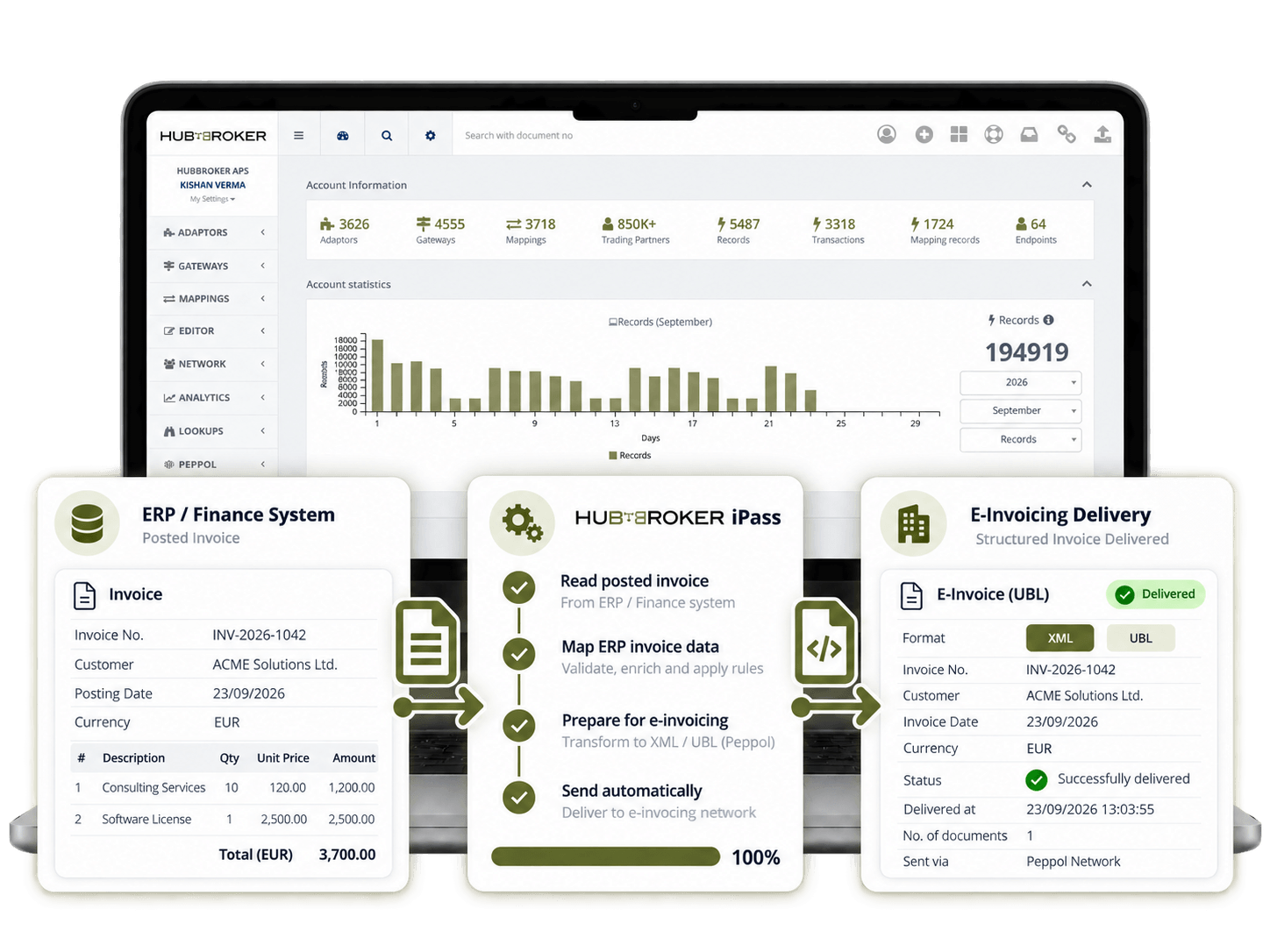
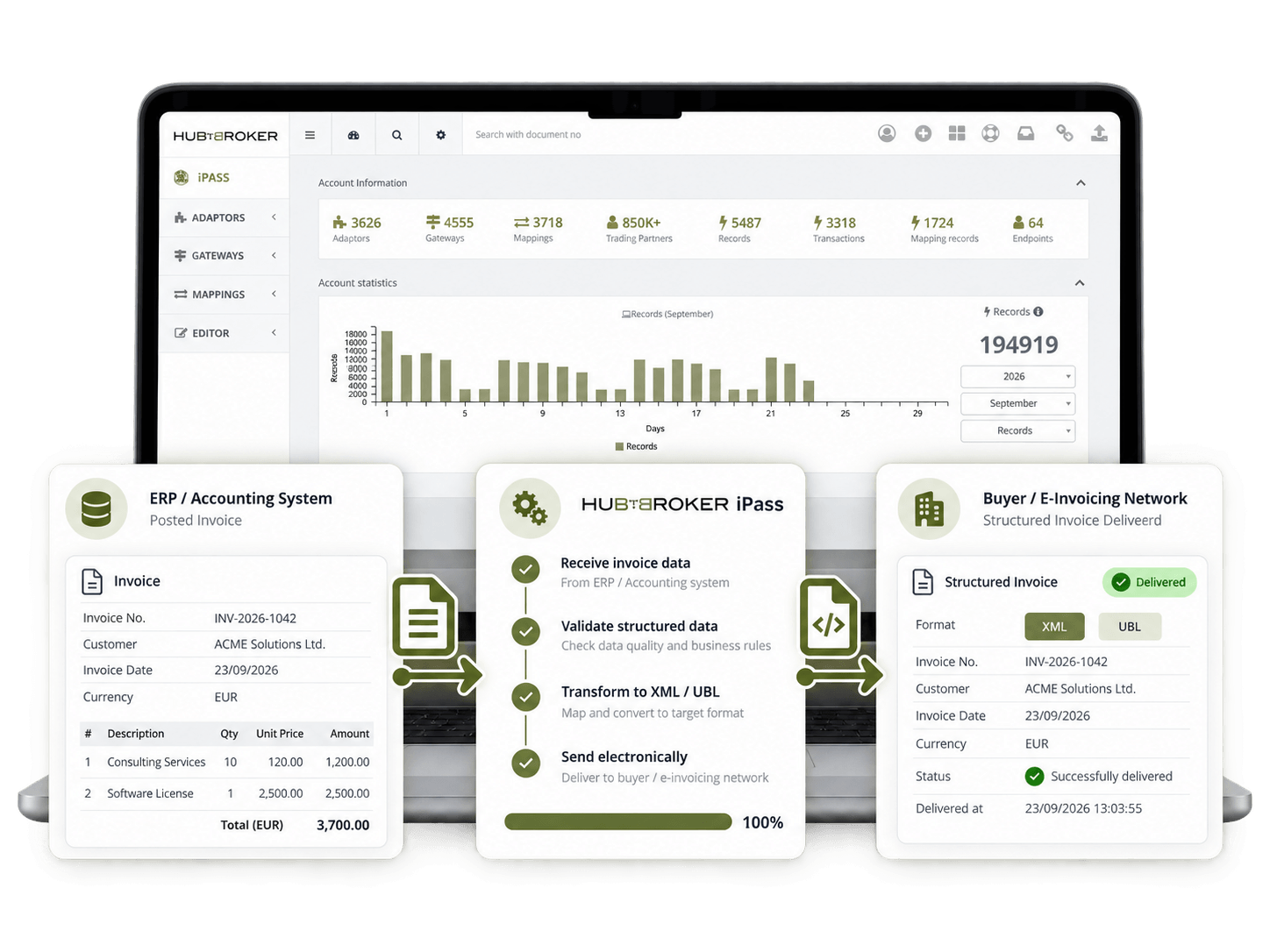
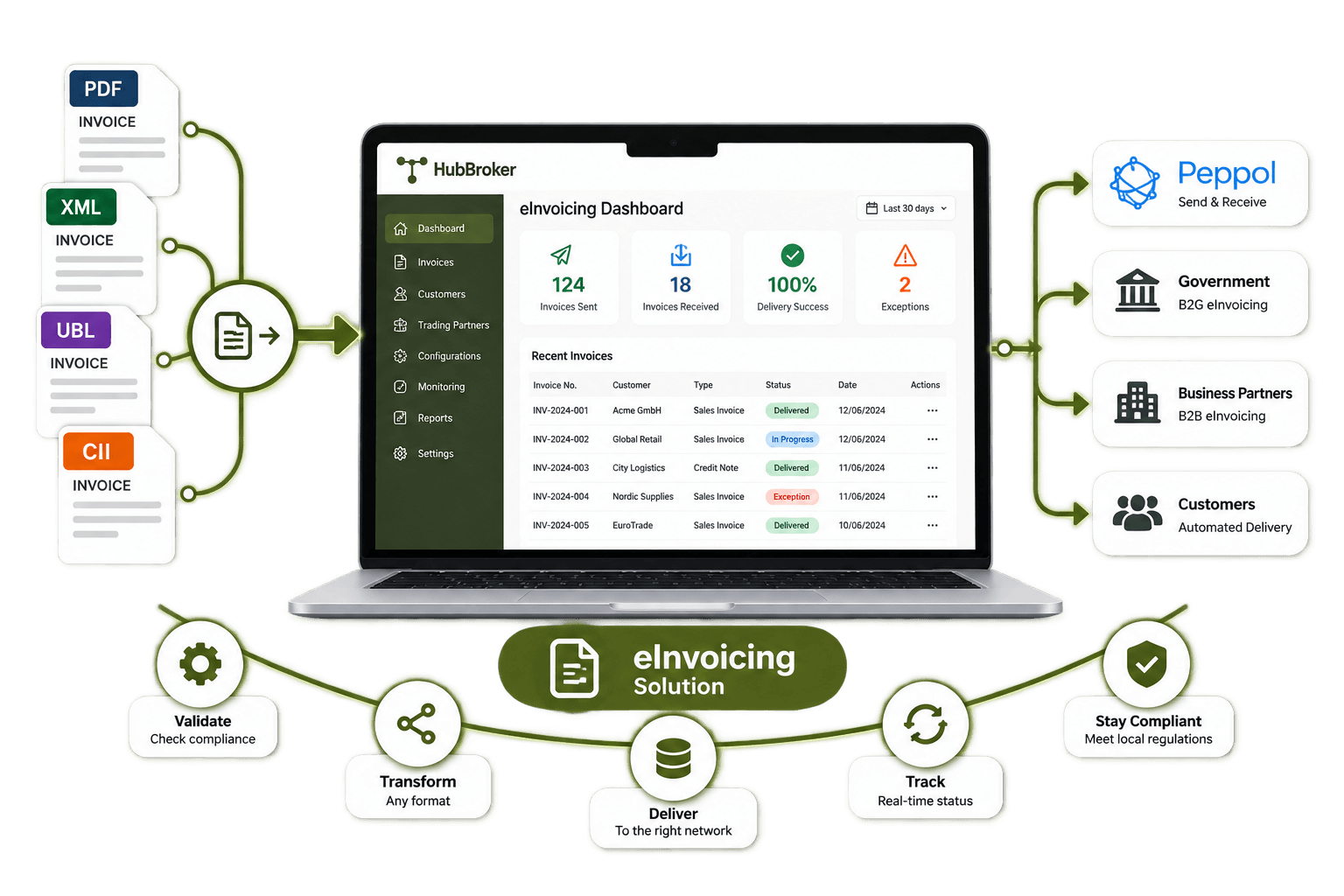
Send and receive invoices in structured formats such as XML or UBL so accounting systems can process invoice data directly without relying on emailed PDFs or manual data entry.
Connect e-invoicing with your ERP or finance system so invoice data moves between systems automatically. A posted invoice can be prepared for delivery without entering it again.
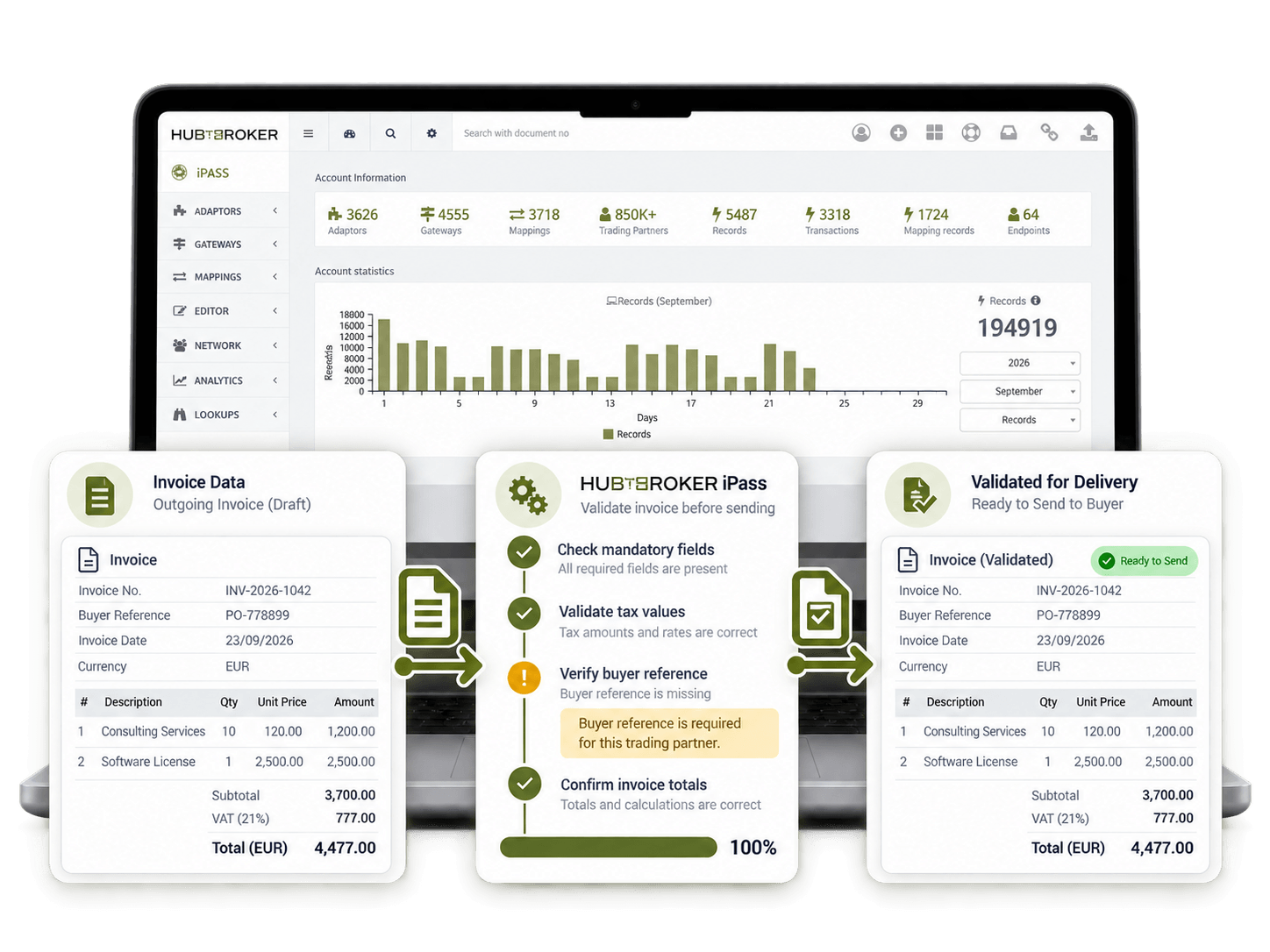
Check required fields, tax values, buyer references and invoice totals before delivery. Missing or incorrect data can be identified before the invoice reaches the customer or network.
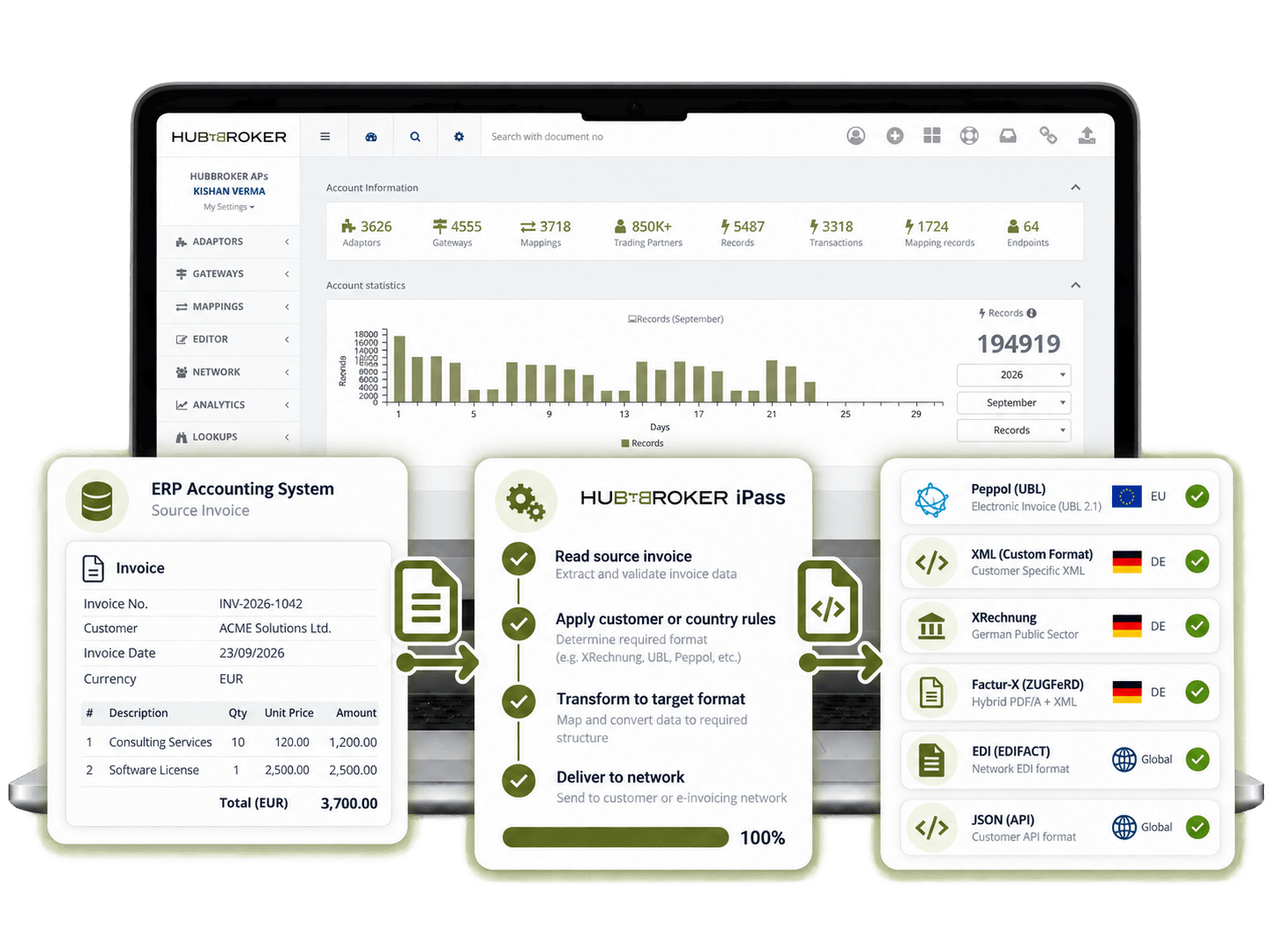
Convert invoice data into the required format for different customers, countries or networks. One ERP invoice can be transformed into the structure expected by each receiving party.
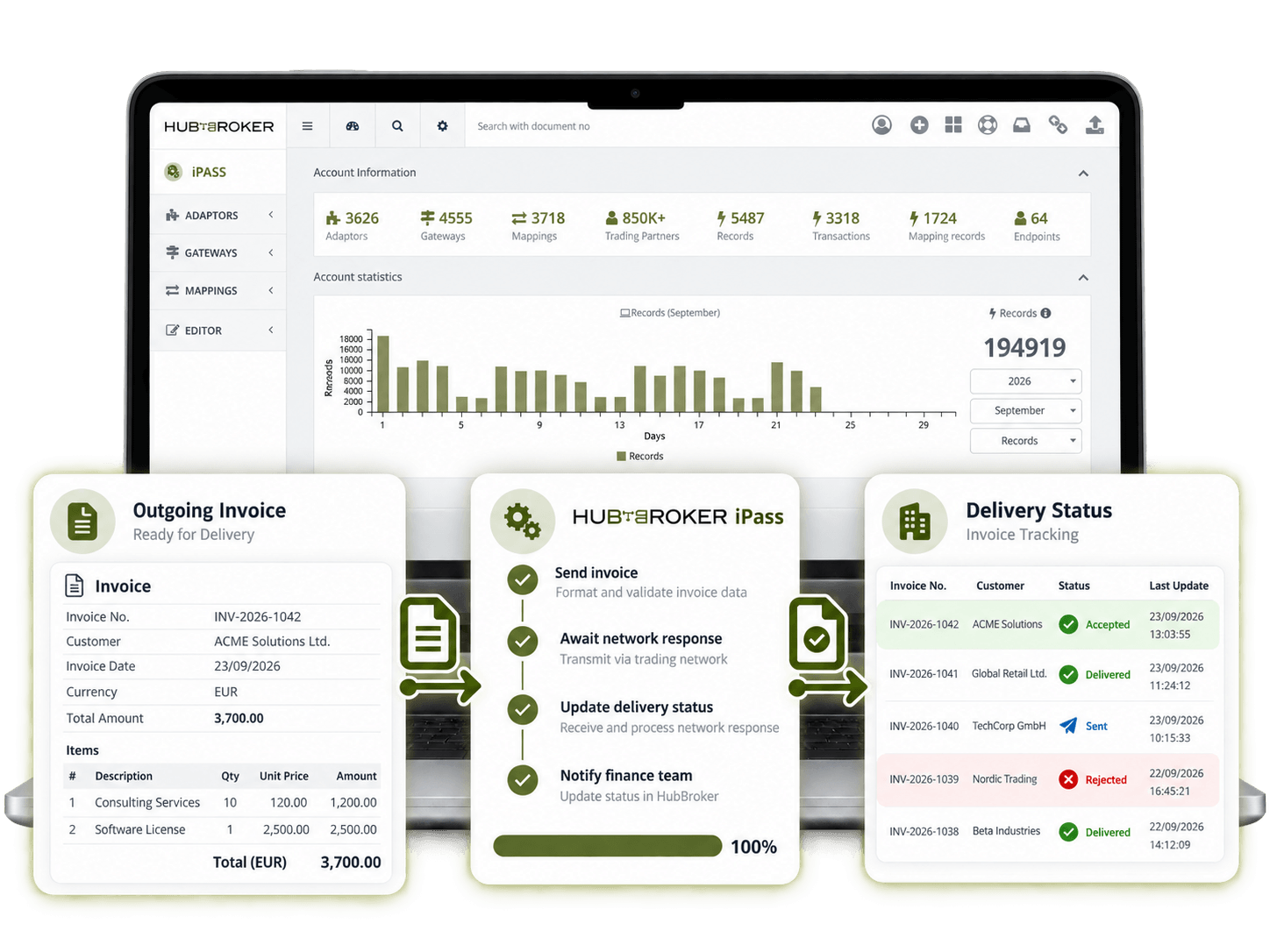
Track whether an invoice has been sent, delivered, accepted or rejected. Finance teams can identify failed invoices quickly instead of waiting for a customer to report a problem.
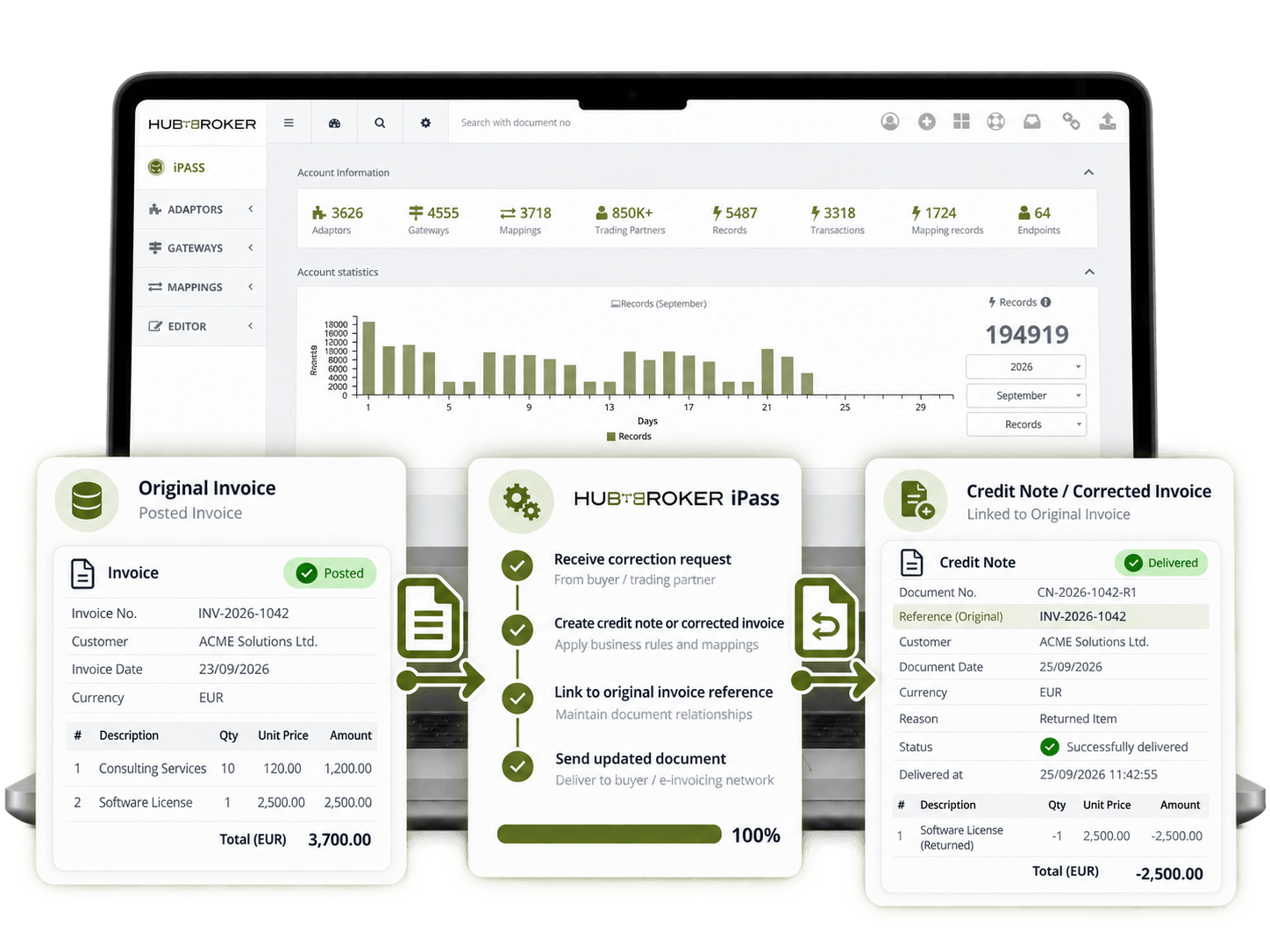
Exchange credit notes and corrected invoices together with the original invoice references. A returned product can be credited while keeping the adjustment linked to the initial sale.
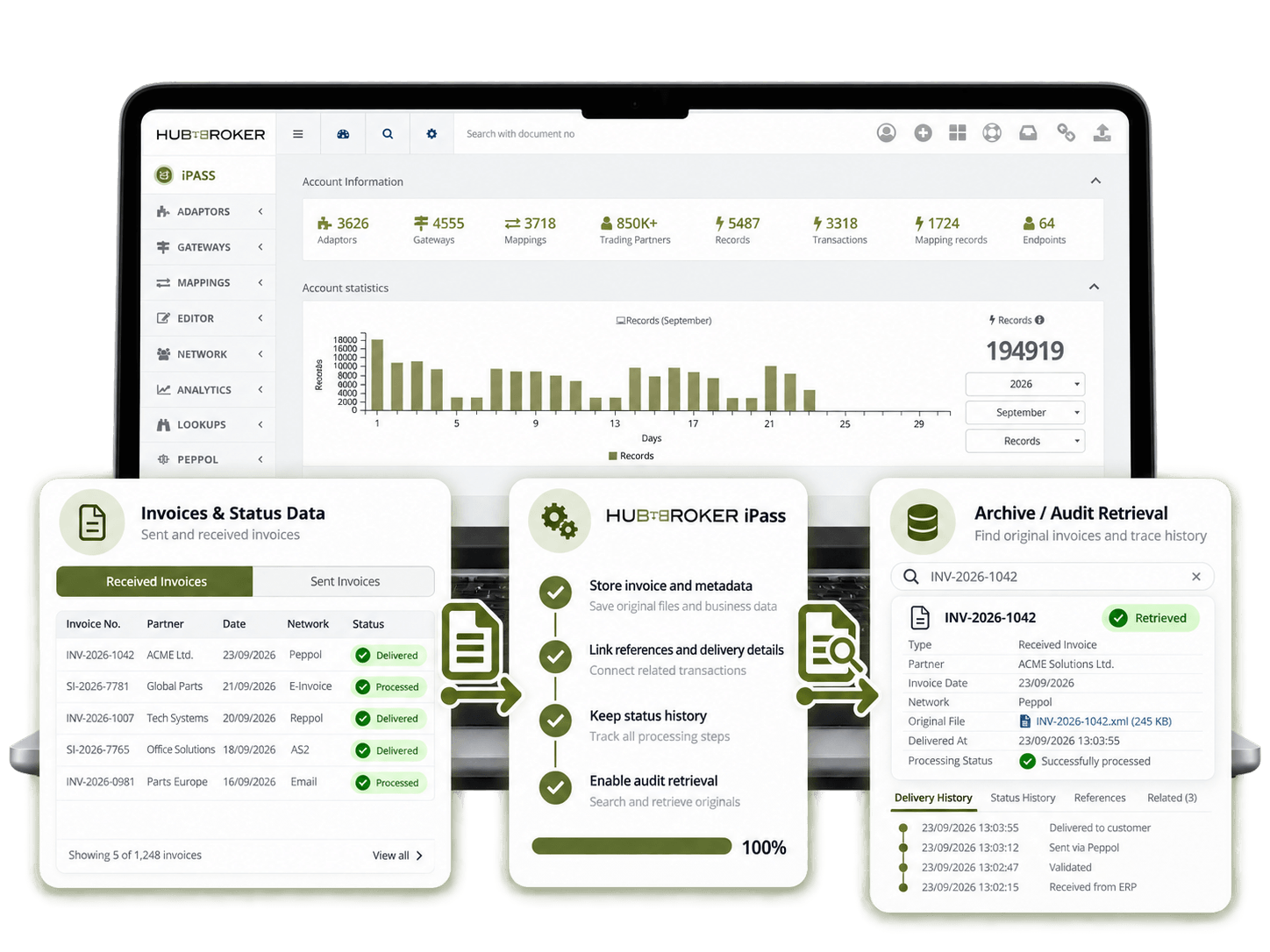
Keep sent and received invoices together with their references, delivery details and processing status. Finance teams can retrieve the original transaction during audits or disputes.
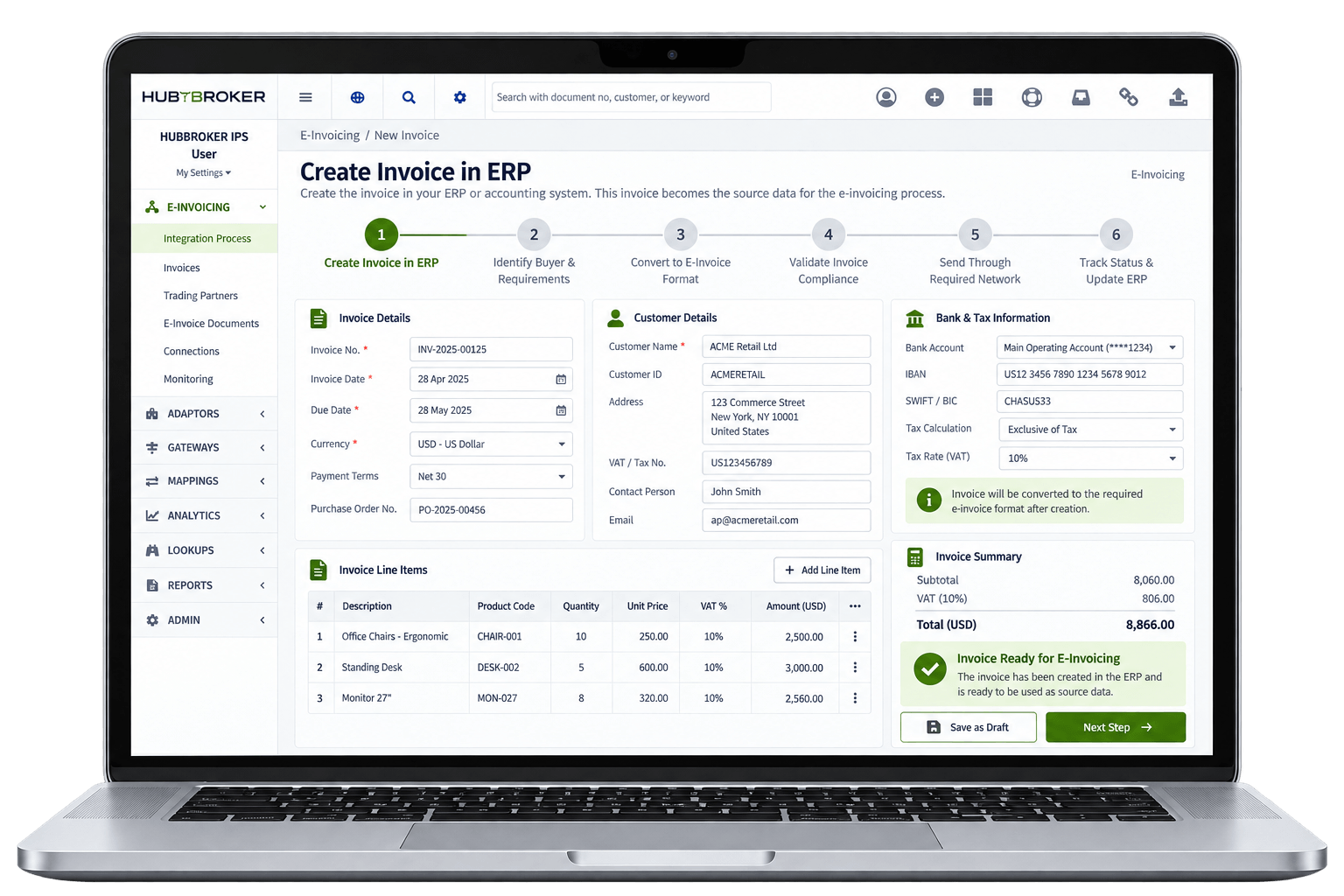
Create the invoice in your ERP or accounting system with the customer details, invoice number, PO reference, line items, tax, totals, payment terms, and bank information. This invoice becomes the main source of data that will be used during the complete e-invoicing process. The process starts from the information already available inside your ERP or accounting system.
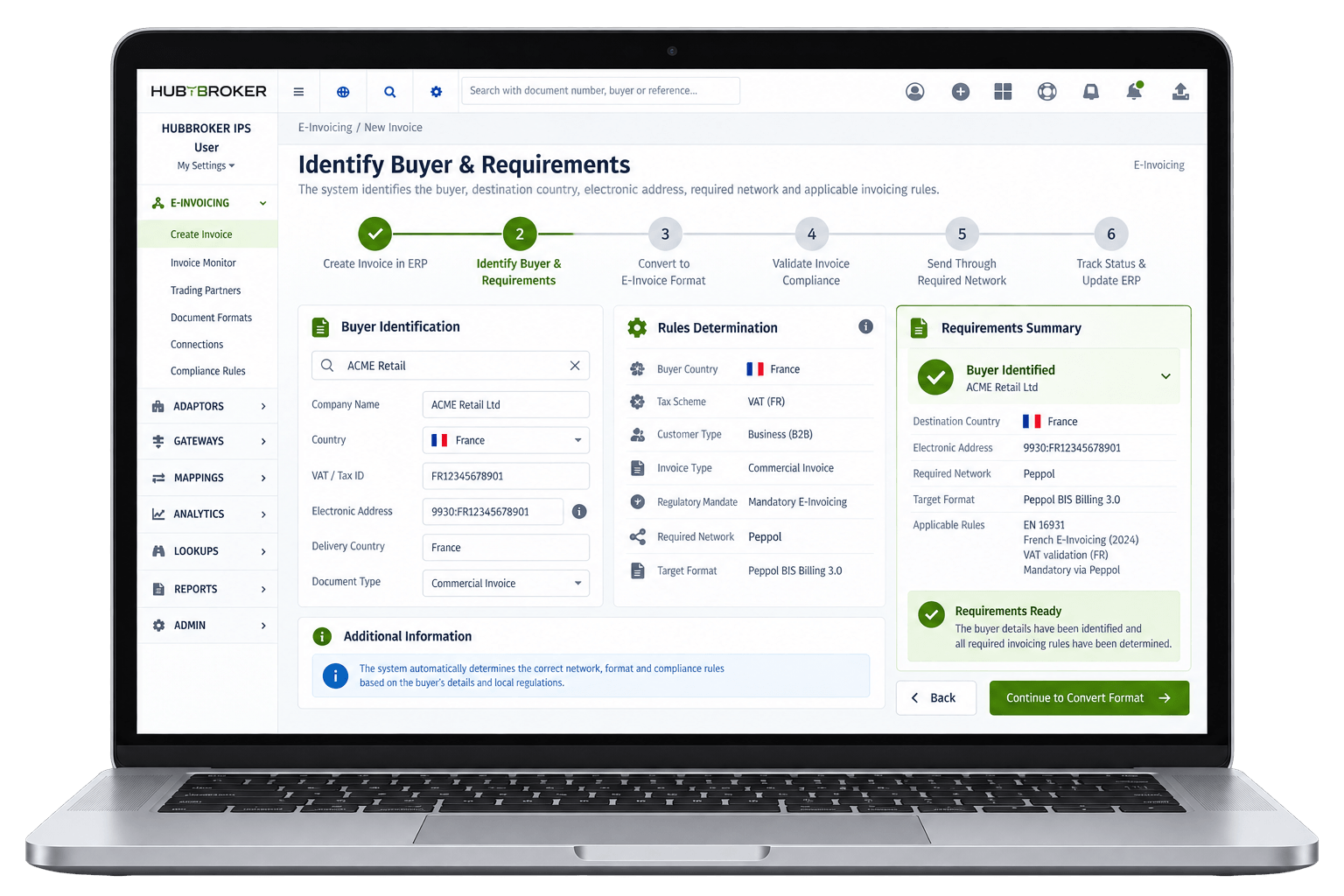
Identify the buyer, destination country, electronic address, required network, and the invoicing rules that apply for the transaction. The system checks whether the invoice needs to go through Peppol, a national e-invoicing platform, or another supported network. It also determines which structured invoice format is required for the buyer or country.
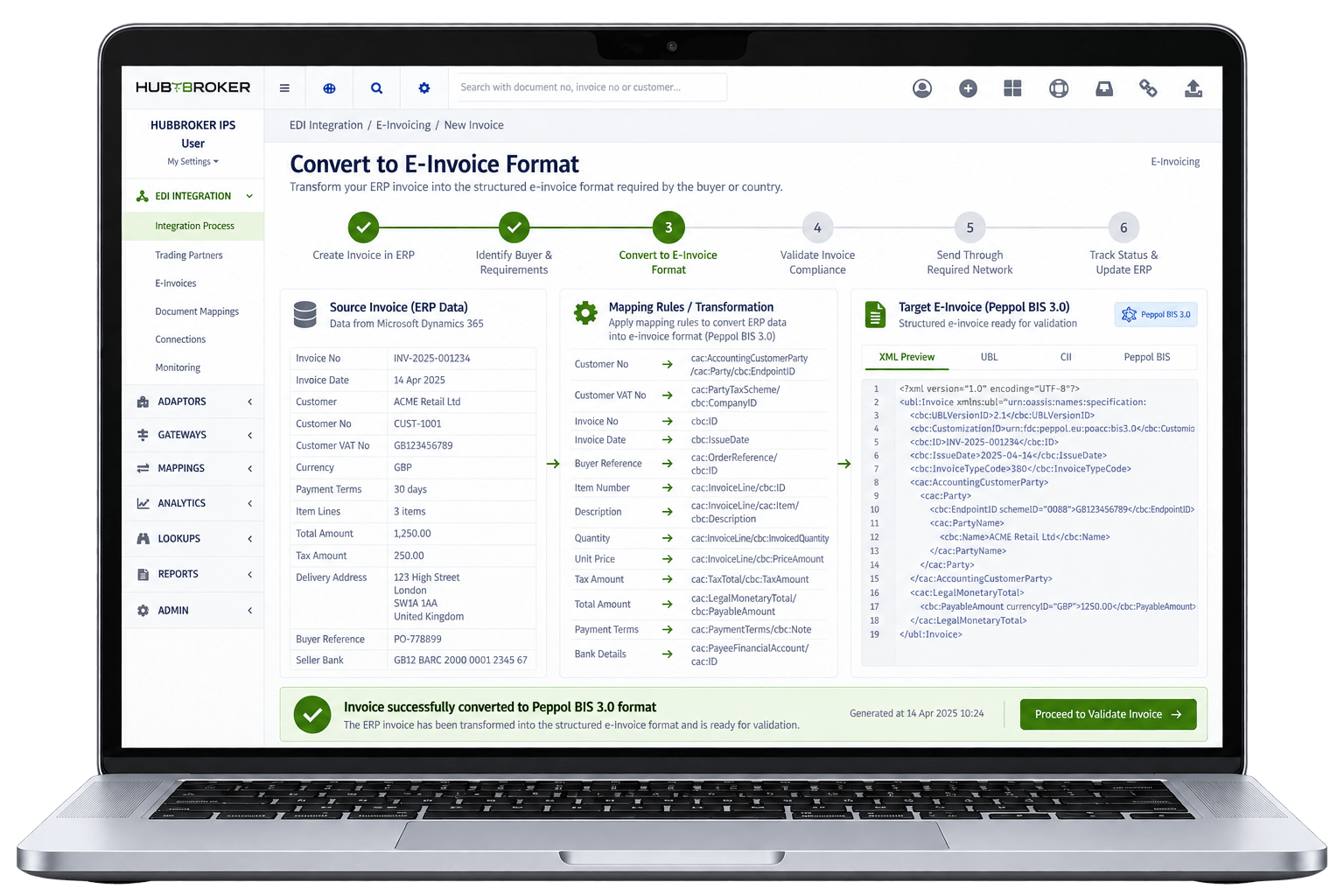
The ERP invoice is converted into the structured format required by the buyer, network, or destination country. This may include Peppol BIS, UBL, CII, or another XML-based invoice format depending on the requirement. Customer IDs, tax information, references, quantities, prices, totals, and payment details are mapped into the correct fields.
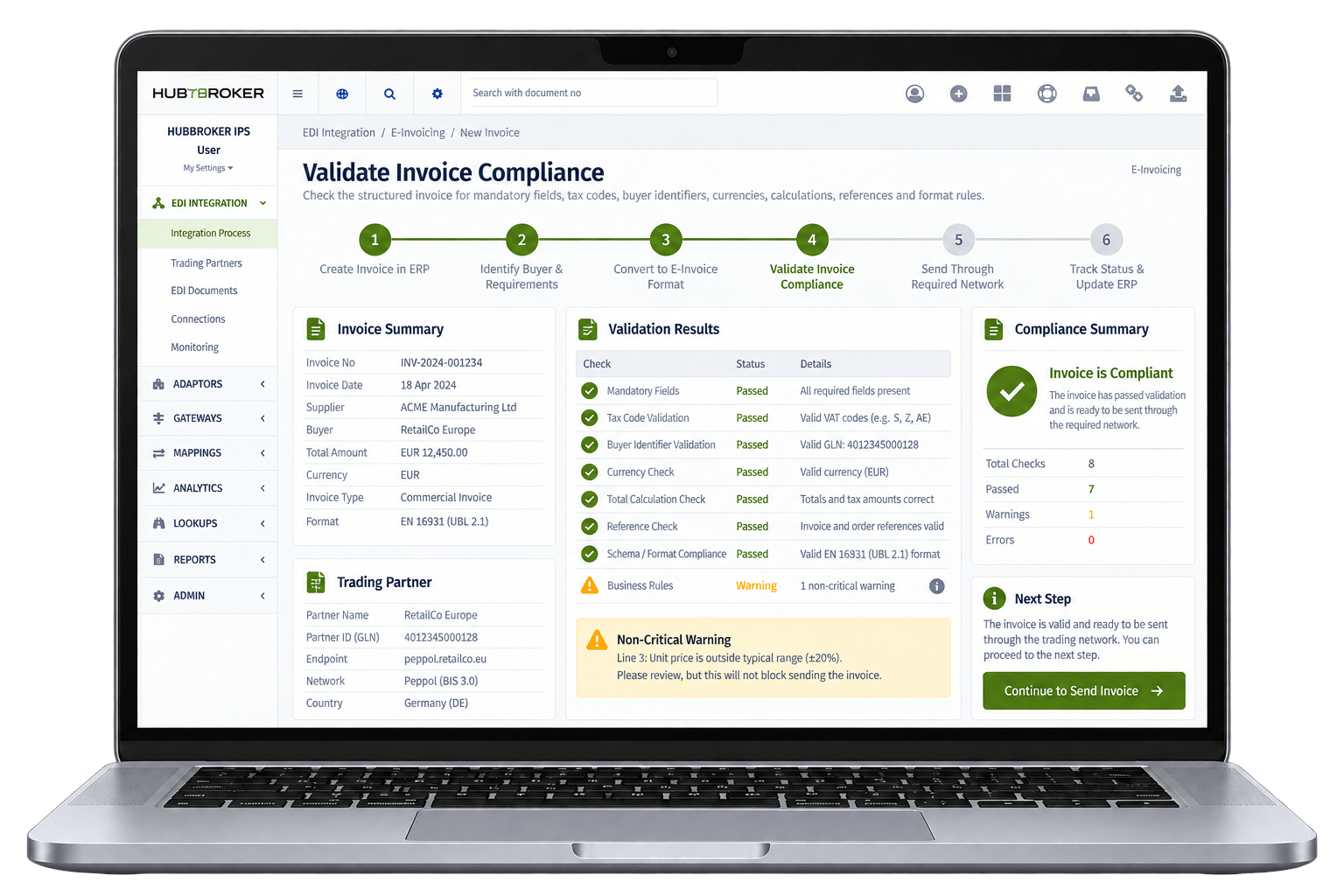
The structured invoice is checked for required fields, tax codes, buyer identifiers, currencies, calculations, references, and format rules. Validation helps find missing or incorrect information before invoice is sent outside your system. Invoices with errors are stopped for correction, so incorrect or non-compliant data does not reach the buyer or tax authority.
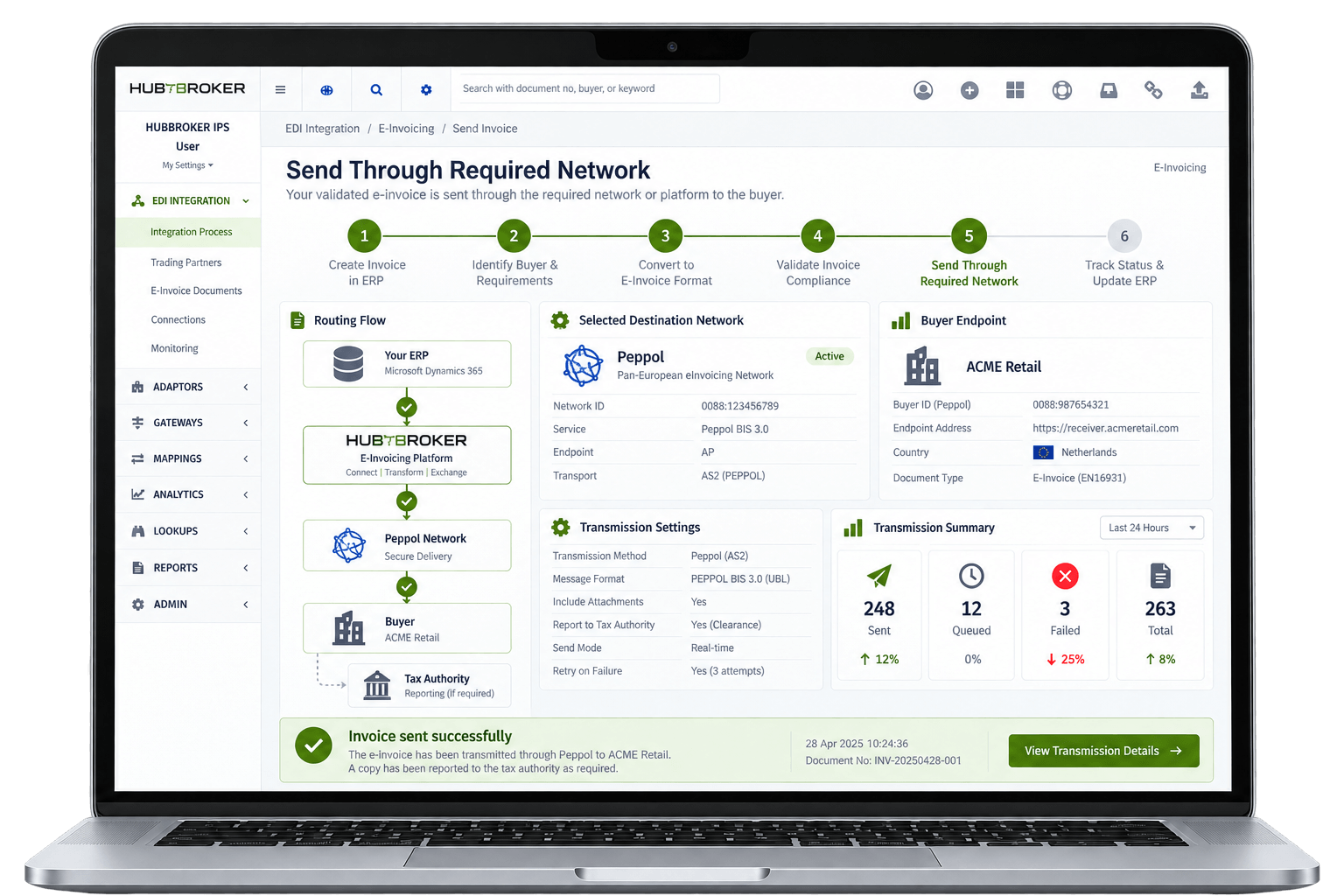
Once the invoice passes validation, it is sent through the required network or platform such as Peppol or a national e-invoicing service. The e-invoice is routed securely to the correct buyer based on their electronic address and network requirements. Where required, invoice information can also be reported to or cleared by the relevant tax authority as part of the same process.
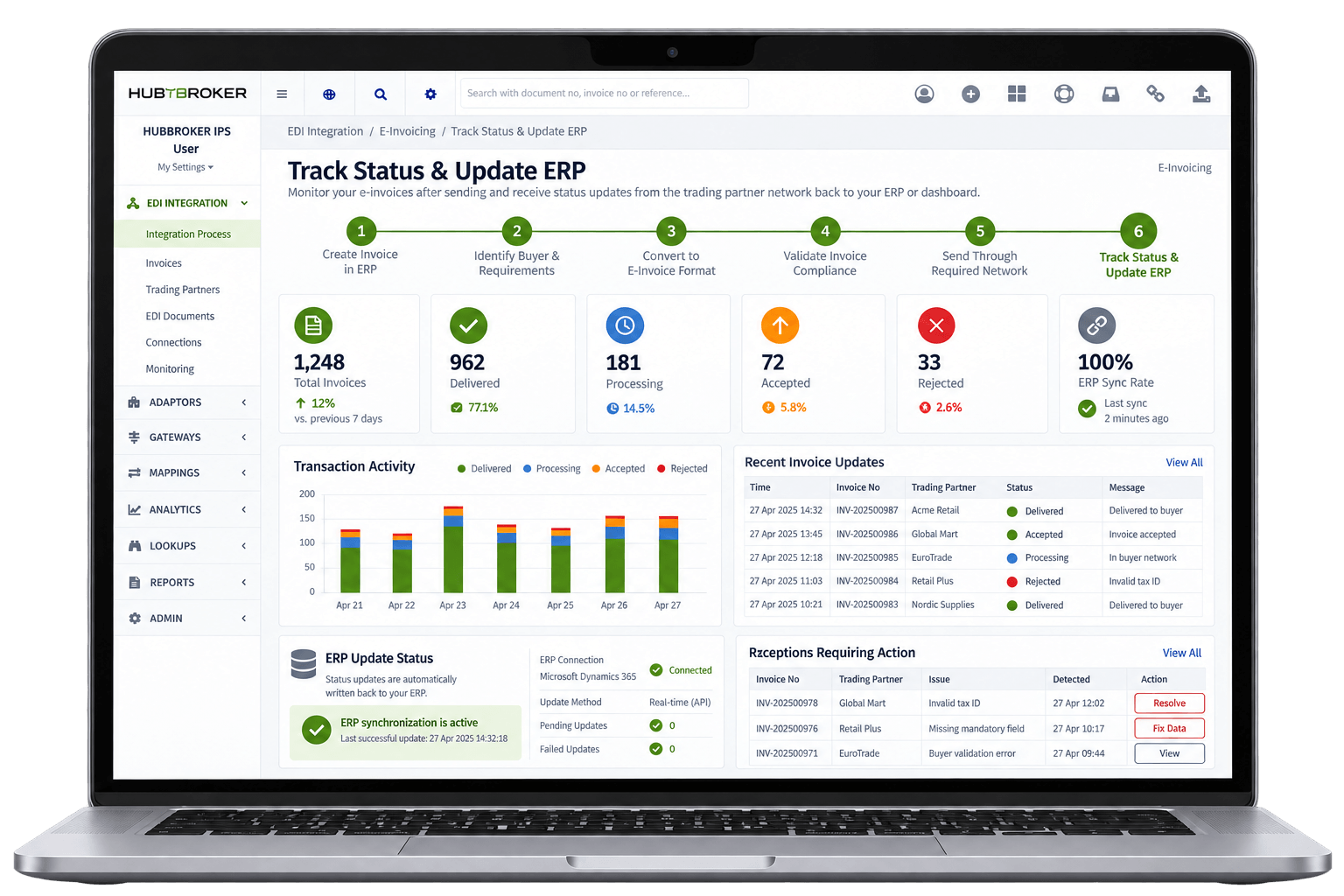
After sending, the invoice status is tracked to see whether it was delivered, accepted, rejected, or still being processed. These status updates can be returned to your ERP or integration dashboard so finance team can easily see what happened with each invoice. This makes it easier to handle rejected invoices and other exceptions without manually checking different external portals.








Send and receive Peppol-compliant e-invoices that meet public-sector mandates across Europe, so growing B2G and B2B requirements do not block your tendering, billing, or contracts.
A single Peppol e-invoicing connection reaches thousands of public and private buyers across Europe, so you do not need to manage separate setups for each ministry, agency, or partner.
E-invoices delivered through Peppol arrive almost instantly compared with email or post, so your customers receive billing faster and your payment cycles start sooner than today.
Outbound and inbound e-invoices are checked against Peppol BIS, country-level rules, and partner-specific profiles, reducing rejections and the support load on your AR and AP teams.
Peppol e-invoice activity is connected directly into your ERP or finance system, so AR, AP, and reporting teams continue to work in their normal tools rather than a separate UI.
Your Peppol e-invoicing setup connects to EDI, intelligent document processing, ERP APIs, and PDF-to-XML in the same platform, so e-invoicing becomes a starting point, not a silo.













HubBroker is an established, certified Peppol Access Point provider, with an active customer base across Denmark and the broader European region using the network for live invoicing each day.
Peppol e-invoicing sits alongside EDI, intelligent document processing, ERP integration, and APIs in the same platform, so B2G and B2B exchange is handled through one consistent setup.
Pre-built connectors for Business Central, SAP B1, Visma e-conomic, Uniconta, Rackbeat, and others let your Peppol setup connect into the finance systems your business already runs.
Our validation and routing accounts for country-specific Peppol BIS profiles, tax requirements, and partner rules across Europe, so e-invoices land cleanly across borders.
Peppol e-invoicing onboarding follows a clear path from registration to go-live, so finance, IT, and procurement teams know what is happening at each stage and timelines stay realistic.
Our teams in Denmark and India support customers directly on Peppol identifiers, document profiles, country-level rules, and ongoing changes, instead of routing you through generic helpdesks.

ERIKS is a globally recognized industrial service provider with over 80 years of experience in delivering technical products, engineering expertise, and tailored services.
Read More
Orkla House Care Europe, a division of Orkla ASA, is a leading manufacturer and distributor of high-quality painting tools for both professionals and DIY users. Operating across Sweden, Denmark, Norway, and the UK.
Read More
Ammega Group, through its Megadyne division, is a global leader in the manufacturing and distribution of power transmission belts and industrial conveyor solutions.
Read More
TDC Brands is a Danish telecommunications group, home to six brands: YouSee, TDC Erhverv, Telmore, Hiper, eesy and Relatel.
Read More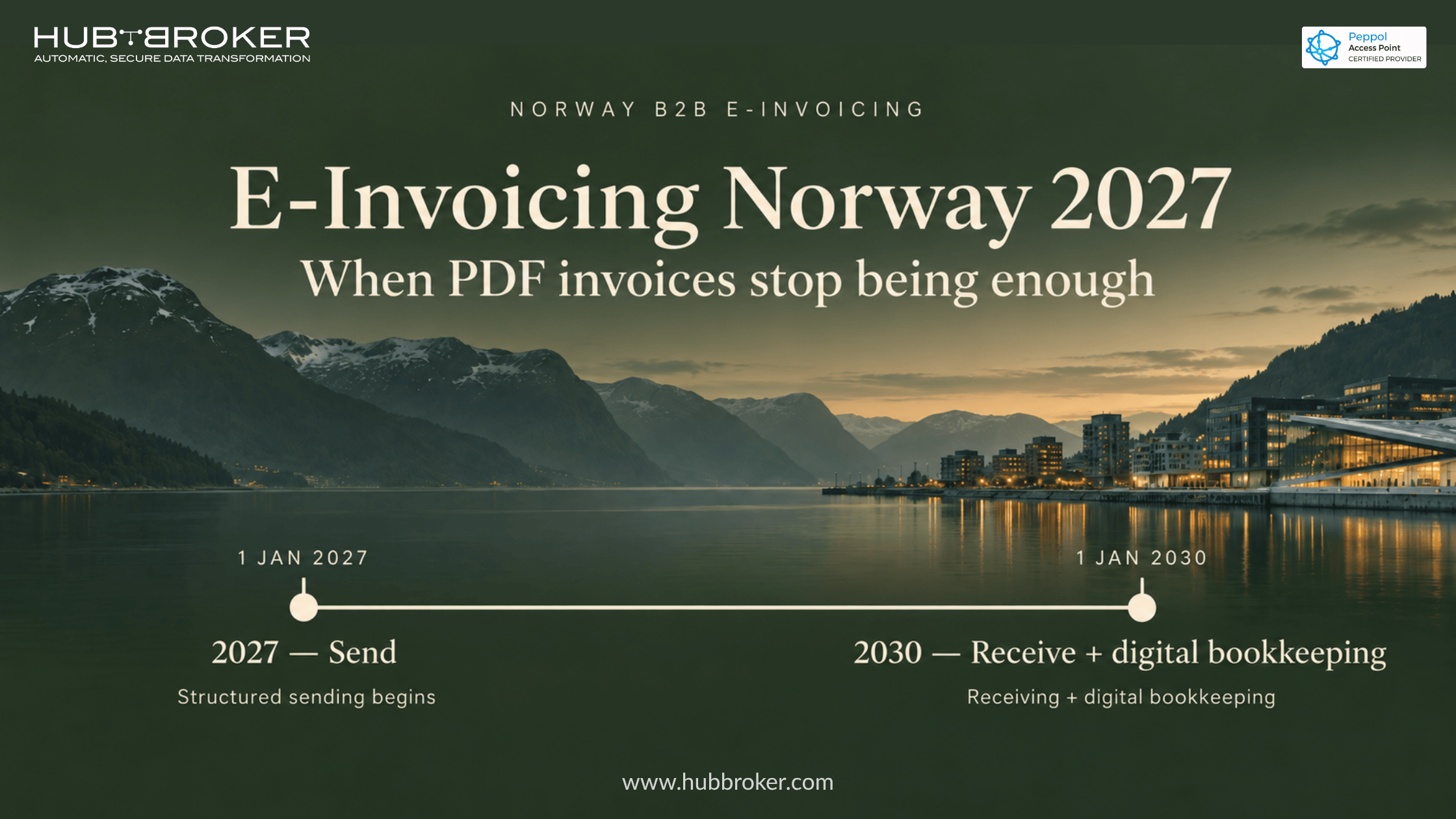
From 1 January 2027, a PDF is no longer a valid B2B invoice in Norway. The 2027 and 2030 deadlines, EHF and Peppol, and how to prepare your ERP.
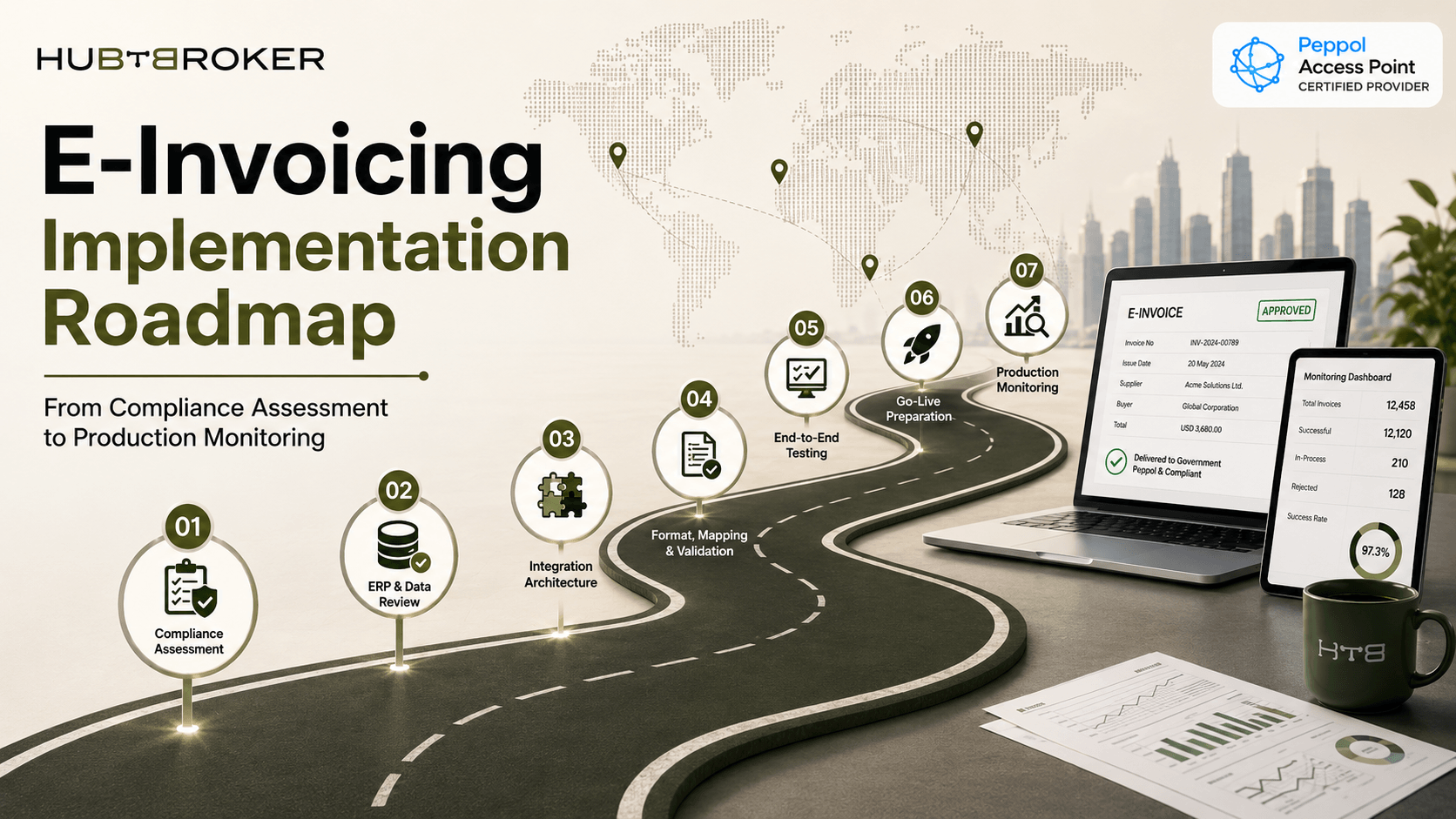
Plan e-invoicing implementation from compliance assessment to production monitoring with a scalable solution built for global regulatory requirements.

Track global e-invoicing deadlines for 2026-2028 and keep finance teams compliant with a scalable solution built for changing country requirements.
An e-invoice (electronic invoicing) is the automated creation, exchange, and processing of structured invoice data between a seller and a buyer. Unlike standard paper or PDF invoices, true e-invoices use machine-readable formats (like XML or JSON) that integrate directly into accounting and ERP systems, entirely eliminating manual data entry.
It applies to B2B (Business-to-Business) transactions and exports only.
E-invoicing mandates are rapidly expanding globally as governments adopt continuous transaction controls (CTCs). Over 60 countries currently require electronic invoicing, particularly across Europe, Latin America, and Asia, to combat tax fraud and streamline tax reporting.
HubBroker solutions support businesses across industries where reliable data exchange, automation, compliance, and partner connectivity are essential.
Support fast-moving order, invoice, inventory, and marketplace workflows with automated document and system integrations.
Help manufacturers connect suppliers, customers, ERP systems, and logistics partners for smoother production and supply chain operations.
Enable structured data exchange for shipping, delivery, tracking, invoicing, and partner communication across logistics networks.
Support secure and accurate document exchange where compliance, reliability, and process efficiency are critical.
Help financial businesses improve document processing, data accuracy, reporting flows, and secure business communication.
Automate order-to-cash and procure-to-pay workflows across customers, suppliers, warehouses, and ERP systems.
Bredgade 45B 1260 , København K Capital Region, Denmark
D-1010, The First, B/H ITC Narmada, Ahmedabad, Gujarat, 380015, India