
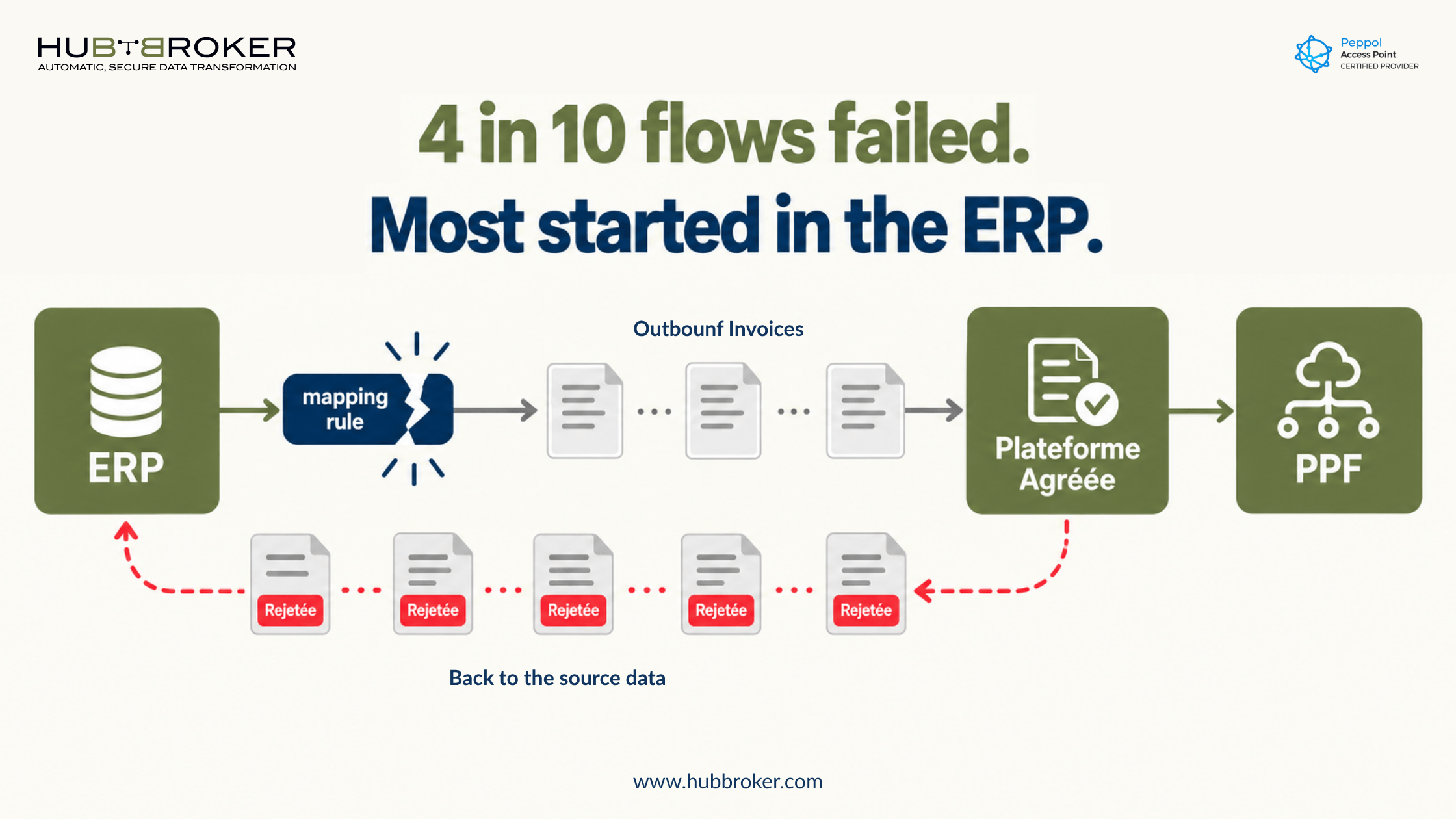
French e-invoicing problems after month one: why 4 in 10 flows failed, and what to fix first
On 10 September, ten days into France's e-invoicing mandate, the Portail Public de Facturation (PPF) received 924,040 invoice flows. 402,423 of them failed compliance checks. That's a 43.5% rejection rate on a single day, based on DGFiP and AIFE monitoring data reported by VATCalc.
Three weeks in, the picture looks better. Most accredited platforms now report compliance rates above 90%. But if your French entity is one of those generating rejections, the average doesn't help you.
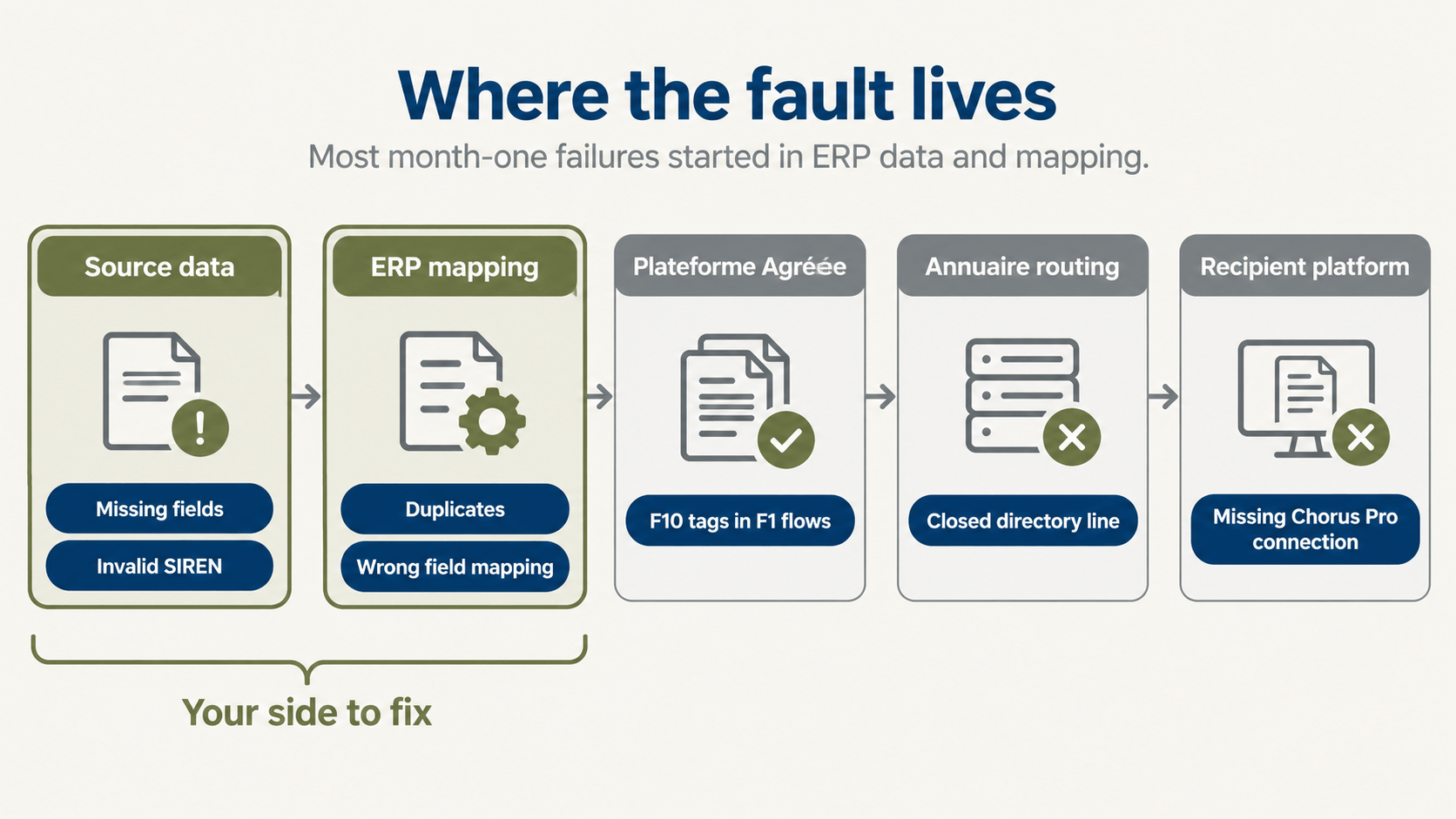
Here's the uncomfortable part. Most French e-invoicing problems in month one weren't platform failures. They started in the ERP.
What actually broke in month one
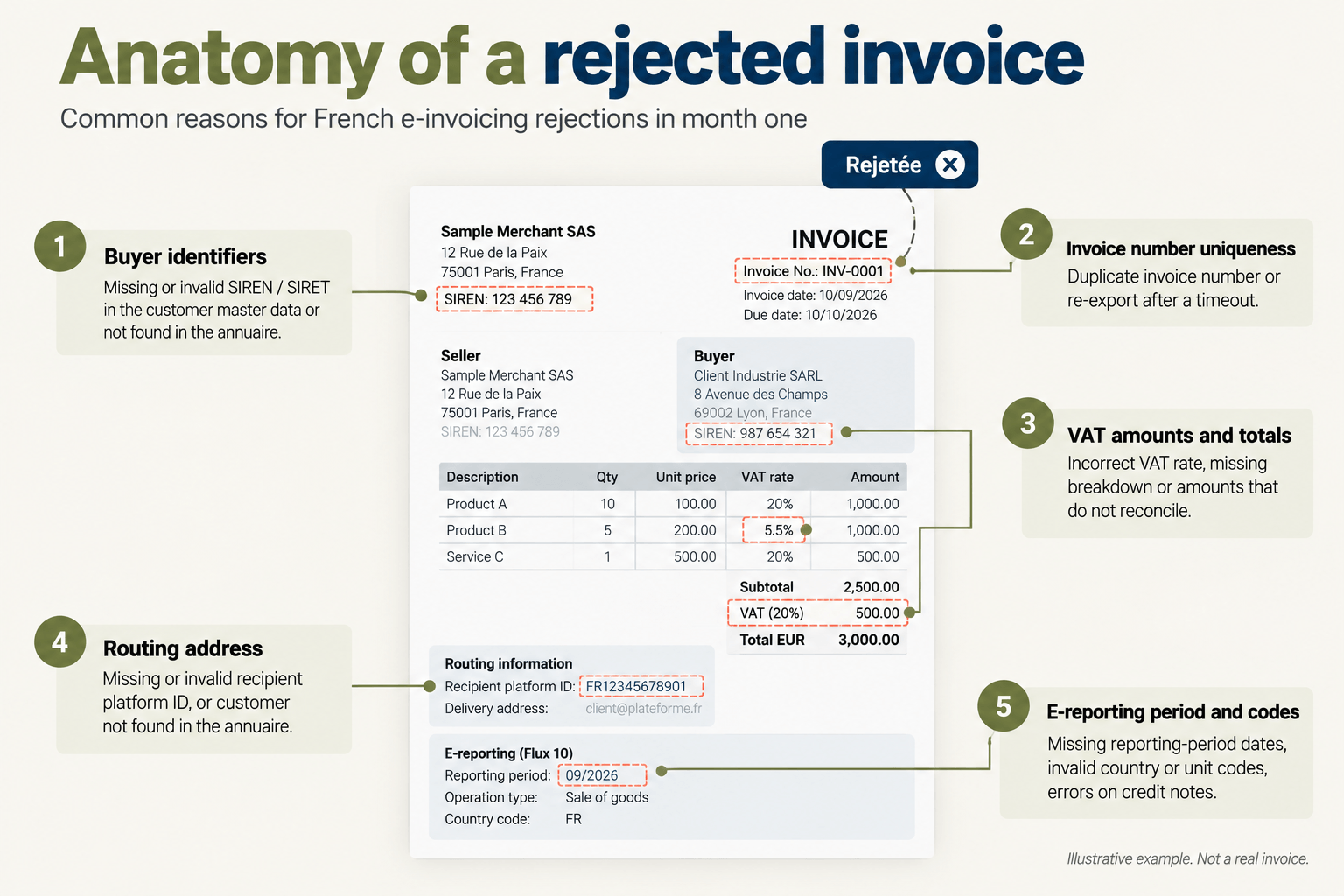
The monitoring data points to five failure patterns. If you work a rejection queue, you'll recognise at least two of them.
Missing mandatory data
Between 11 and 13 September, around 32% of non-compliant flows failed because mandatory data was missing. These are the gaps a PDF tolerated for years: a field nobody read, or a value a person filled in mentally before paying.
Invalid identifiers and VAT inconsistencies
SIREN numbers missing from the annuaire, invalid business identifiers and VAT data that doesn't reconcile all show up in the rejection reasons.
Format choices play a part too. If your profile doesn't carry the data the receiving side validates, the invoice fails before anyone opens it. Our comparison of Factur-X profiles explains which profile carries what.
Duplicate invoices
Uniqueness checks caught invoices sent twice. The usual causes are a retry loop, a re-export after a timeout, or two systems issuing the same document.
Platforms that weren't fully connected
Connected doesn't mean connected end to end. By 21 September, only 63 of roughly 150 Plateformes Agréées (PAs) were connected to Chorus Pro, and 310 public-sector invoices were waiting on 28 platforms without that connection.
Directory handovers caused rejections as well. When a PA closes a company's last active annuaire line after a contract ends, the company can be left without a routing address.
E-reporting with the same faults
Flux 10 e-reporting shows similar problems: missing reporting-period dates, invalid country and unit codes, and errors on credit notes.
Why most French e-invoicing problems start in the ERP
A Plateforme Agréée can detect bad data and reject it. It can't correct the customer record in your ERP. That part is yours.
One configuration error, thousands of rejections
Between 18 and 20 September, 142,923 F1 files failed compliance checks. A large share came from one platform placing F10 e-reporting tags inside F1 invoice flows. One mapping error, repeated on every invoice that passed through it.
The same logic applies on your side. A wrong field mapping doesn't fail once. It fails on every invoice until someone fixes the rule, which is why ERP integration deserves the same scrutiny as your platform contract.
Master data that was good enough for PDF
Imperfect customer data could sit in an ERP for years because a person read the invoice and paid it anyway. Automated validation has no such tolerance.
Native ERP e-invoicing features build the file. They don't clean the data behind it, as we cover in our look at Business Central e-documents.
The month-two fix list
Start with the fixes that clear the most rejections per hour of effort.
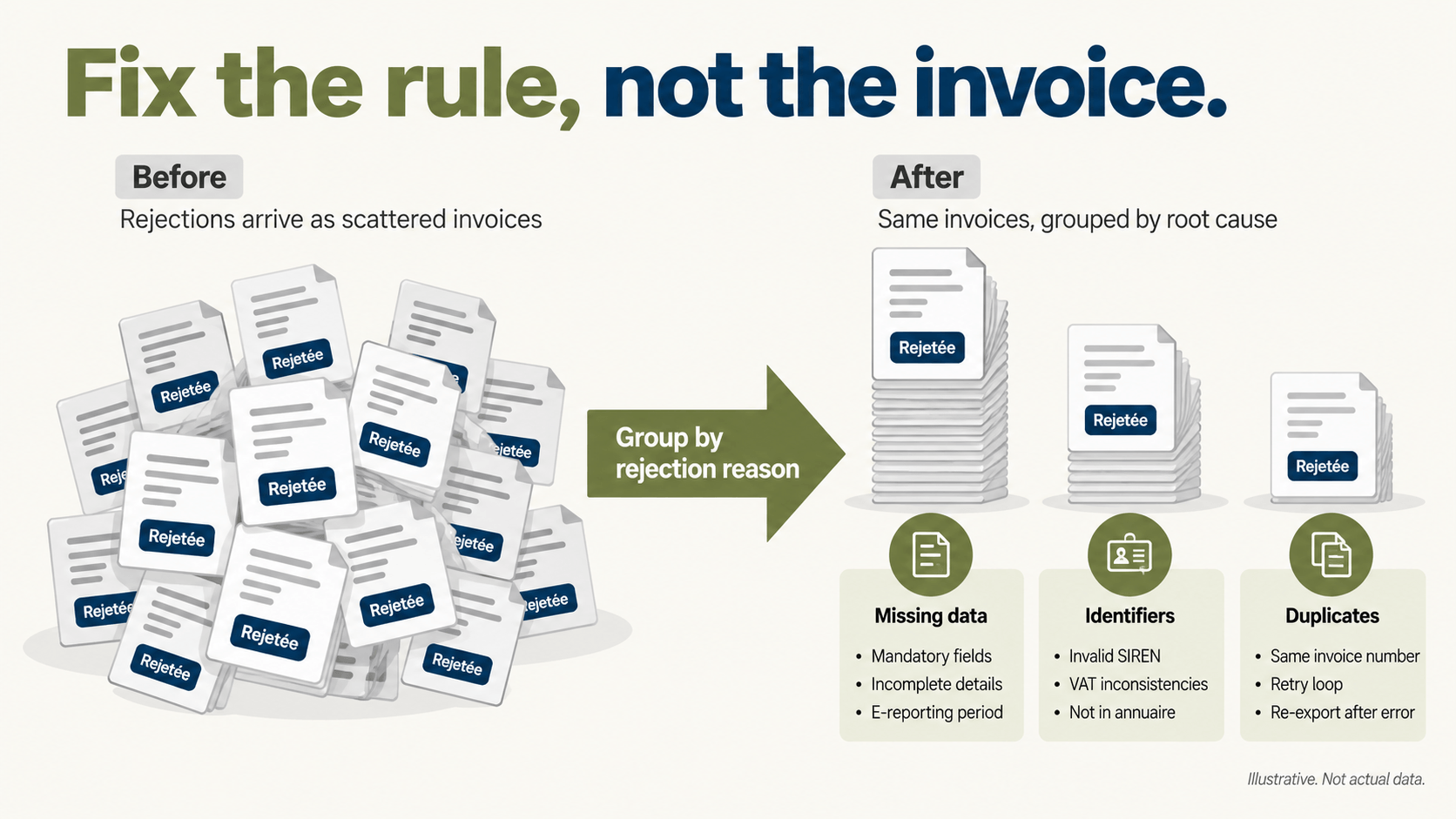
Triage rejections by root cause, not invoice by invoice
Export your rejections, group them by rejection reason and count. If one reason accounts for half your volume, you haven't got 500 broken invoices. You've got one broken rule.
Fix SIREN, SIRET and VAT data at the source
Correct the customer and supplier records in the ERP, not the outgoing file. Patch the file and you'll fix the same error again next month.
Route lifecycle statuses into AR and AP
A Rejetée status (rejected by the platform) or a Refusée status (refused by the recipient) only helps if someone sees it the same day. Check that statuses reach your finance system, not just a platform portal.
Handle recipients missing from the annuaire
Directory coverage was incomplete at go-live, so some customers can't be found. Follow the official exception procedure rather than inventing a workaround, and log every case.
Check your PA connection and inbound reception address
Confirm your SIREN is registered in the annuaire with the correct reception address. Then confirm your PA covers every route you need, including Chorus Pro if you invoice the public sector.
If you're reviewing your platform, our seven questions for choosing a Plateforme Agréée apply just as well after signature.
The soft landing isn't a free pass
In July, Minister for Public Accounts David Amiel said there would be no sanctions at the start of the reform for good-faith businesses that run into a difficulty, document it and take steps to correct it. That's tolerance on enforcement, not a pause on the obligation.
The penalties are already in law. Article 1737 of the Code général des impôts sets a fine of €50 per invoice not issued electronically, capped at €15,000 per calendar year. Missing e-reporting transmissions carry a separate fine.
Notice the word "document" in the minister's statement. Keep a dated log of each rejection cause, what you changed and when. That log is your good-faith evidence.
What month one tells SMEs about September 2027
Small and micro-enterprises start issuing e-invoices on 1 September 2027. They'll meet the same data problems with smaller teams to fix them.
If you support French SMEs, treat month one as a free rehearsal. Our guide to the September 2027 wave sets out a 12-month plan.
FAQ
Why are so many French e-invoices being rejected?
Mostly data quality: missing mandatory fields, invalid SIREN identifiers, VAT inconsistencies and duplicate invoices. A smaller share came from platform configuration errors, including one platform that caused a large volume of rejections on its own.
Is there a grace period for French e-invoicing penalties?
Not in law. The government has announced a tolerant approach for good-faith businesses that document their difficulties and correct them. The obligation itself has applied since 1 September 2026.
What should I do if my customer isn't in the annuaire?
Use the official exception procedure, record the case and recheck the directory regularly. Don't fall back to email PDF as a default.
Do PDF invoices count after 1 September 2026?
It depends on who issues them. Large enterprises and ETIs must issue in-scope domestic B2B invoices electronically through a PA, so an emailed PDF doesn't meet the obligation. Small and micro-enterprises follow from 1 September 2027, but every business in scope must already be able to receive e-invoices.
Is it our platform's fault or our ERP's?
Check the rejection reason. Missing fields, wrong identifiers and duplicates usually trace back to ERP data or mapping. Structural errors that appear across many customers at once point to platform configuration.
Getting month two right
You don't need a new ERP to fix this. HubBroker iPaaS sits between your existing ERP and the Plateforme Agréée you've chosen, handling the mapping and validating invoice data before it leaves your system. See how our e-invoicing solution connects the two.
If your rejection queue is telling you something you can't yet explain, talk to us and we'll help you find the rule behind it.
